Measure the space
Find the volume in cubic feet (or convert cubic yards ×27). The new project planner above calculates volume directly from slab, round form, or post-hole dimensions. Use the advanced mode if you already know the exact volume.
Calculate how many 40, 60 or 80 lb concrete bags you need from slab, pier or post-hole measurements. Select a published product yield, then check the count and dry handling weight. Supplier prices are optional.
Choose your project, enter the actual measurements, then see bags, dry handling weight, estimated materials cost and a ready-mix quote comparison in one place. No price is invented.
Comparing bagged concrete with a ready-mix truck? This free purchase planner also accepts your actual bag price, ready-mix price per cubic yard, delivery charge, short-load fee and supplier minimum/order increment. Open the Optional: Compare prices from your suppliers section after entering measurements. It compares entered material and delivery costs; you can also estimate optional bag-mixing rental and labor separately below, without treating them as equivalent installed ready-mix costs. See the bagged-vs-ready-mix decision guide.
With a 10% optional material allowance, a 10 × 10 ft slab at 4 in thickness requires 36.6667 ft³ of concrete. Using QUIKRETE Concrete Mix No. 1101 published approximate bag yields, that means 62 × 80 lb bags, 82 × 60 lb bags, or 123 × 40 lb bags. Without the 10% allowance, the requirements differ. Enter your own dimensions and product above or below to calculate the actual project.
Method: 10 × 10 × (4 ÷ 12) × 1.10 = 36.6667 ft³, divided by 0.60 / 0.45 / 0.30 ft³ per bag, rounded up once. Manufacturer data sheet. Confirm the exact SKU yield before buying.
Just need a quick answer? See the 8×8, 10×10 and 12×12 ft bag-count comparison ↓
Already know the concrete volume, or want to find how much area your bags cover? Open this optional estimator. For project dimensions, use the quick calculator above.
Use a named manufacturer mix or edit yield from your own product label. Concrete is not interchangeable with self-leveling compound.
Start with project dimensions. The calculation converts your measured shape to volume, adds any allowance once, and divides by the exact product yield before rounding up to whole bags.
Find the volume in cubic feet (or convert cubic yards ×27). The new project planner above calculates volume directly from slab, round form, or post-hole dimensions. Use the advanced mode if you already know the exact volume.
A bag labeled 80 lb does not always imply one universal volume. For QUIKRETE Concrete Mix No. 1101, the stated 80 lb yield is approximately 0.60 ft³.
Multiply net volume by the waste factor, divide by the selected yield, then round up once. Do not truncate to 0.022 cubic yards per bag first.
For QUIKRETE Concrete Mix No. 1101, the manufacturer publishes approximately 0.60 ft³ yield for an 80 lb bag. One cubic yard is 27 ft³, so the theoretical number of bags with zero waste is 27 ÷ 0.60 = 45 whole bags.
Always confirm the product and installation assumptions before purchasing.
Mortar, post-setting mix and self-leveling underlayment may have different yields even for similar package weights.
Use 0% allowance if you want a pure mathematical result; choose a larger percentage only when project conditions justify it.
Already own bags? Enter their count and planned thickness to estimate a rectangular coverage area, assuming the whole mixed yield is placed uniformly.
Start with the geometry, apply your chosen extra-material allowance, and round up to full bags using the yield of your actual concrete mix.
Illustrative price comparison, not current store pricing: at a hypothetical $6 per bag, materials are $372. If a supplier instead quotes $170/yd³ plus $50 delivery and $30 short-load, and explicitly confirms a zero minimum and no billing increment, the modeled ready-mix subtotal is $310.86. The $61.14 difference does not include taxes, labor, mixing equipment, site access, waiting time or other fees. Do not assume unknown terms equal zero.
For a different shape, use the Sonotube calculator or post-hole calculator; for supplier-independent volume, start with the slab volume calculator. Verify the manufacturer's current product data sheet for your exact SKU.
Already have a volume but not sure how to buy? Compare bagged mix with ready-mix delivery, bag handling weight and real supplier fees. To work from square feet and slab thickness, see the concrete-yard coverage estimator.
One cubic yard equals 27 cubic feet. For QUIKRETE Concrete Mix No. 1101, the manufacturer lists different approximate yields for each bag weight; choose the exact bag product you plan to buy.
| Bag size | Approx. yield | 1 yd³ · 0% extra | 1 yd³ · +10% example |
|---|---|---|---|
| 40 lb | 0.300 ft³ / bag | 90 bags | 99 bags |
| 50 lb | 0.375 ft³ / bag | 72 bags | 80 bags |
| 60 lb | 0.450 ft³ / bag | 60 bags | 66 bags |
| 80 lb | 0.600 ft³ / bag | 45 bags | 50 bags |
Formula: round up (27 ft³ × (1 + allowance) ÷ yield per bag). The 10% column is an optional illustration, not a rule. Do not generalize these yields to other brands or mix types. Verify the manufacturer's product sheet before ordering. For an actual slab, enter its dimensions in the bag calculator.
Choose a slab size and thickness, then compare whole-bag counts for 80 lb, 60 lb and 40 lb concrete mixes. These are illustrated with QUIKRETE Concrete Mix No. 1101 yields, not universal values for every brand.
| Slab size | Thickness | Net volume | 80 lb · 0% | 80 lb · +10% | 60 lb · +10% | 40 lb · +10% |
|---|---|---|---|---|---|---|
| 8 × 8 ft | 4 in | 0.79 yd³ | 36 | 40 | 53 | 79 |
| 10 × 10 ft | 4 in | 1.23 yd³ | 56 | 62 | 82 | 123 |
| 10 × 10 ft | 6 in | 1.85 yd³ | 84 | 92 | 123 | 184 |
| 10 × 12 ft | 4 in | 1.48 yd³ | 67 | 74 | 98 | 147 |
| 12 × 12 ft | 4 in | 1.78 yd³ | 80 | 88 | 118 | 176 |
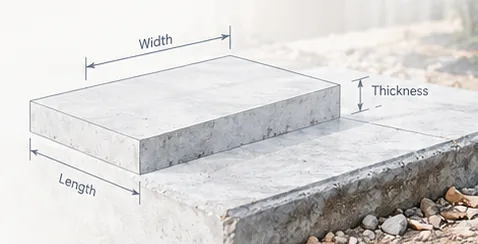
How the table is calculated: length (ft) × width (ft) × thickness (in) ÷ 12 gives cubic feet. Multiply by 1.10 only in the +10% columns, then divide by the chosen bag's approximate mixed yield and round up to a whole bag.
Example: a 10 × 10 ft slab at 4 inches needs approximately 56 × 80 lb bags with 0% extra or 62 × 80 lb, 82 × 60 lb, or 123 × 40 lb bags with 10% extra. The 62-bag choice weighs 4,960 lb dry before pallets, water and equipment.
Choose the right order: +10% is an example setting, not a required or universal waste factor. Confirm the actual bag yield and conditions. For dozens of bags, obtain an itemized ready-mix quote comparison and check truck access, crew availability, handling weight and mixing capacity before buying. Bagged materials may not be the practical choice for every pour.
Product yield assumptions: QUIKRETE Concrete Mix No. 1101 data sheet (40 lb ≈ 0.30 ft³; 60 lb ≈ 0.45 ft³; 80 lb ≈ 0.60 ft³). Results are estimates, not structural recommendations or live supplier prices.
The right number of bags still needs to be matched to the exact product yield, handling weight and the practical size of the pour.
Answers to real measurement and purchase questions. Product data and field conditions can change actual requirements.
Yes. Use the project planner above to enter a slab or rectangular footing, a round pier/Sonotube, or post holes containing embedded posts. The results show volume, bag quantity and handling weight on the same page.
Enter the real price per bag and your ready-mix supplier quote, including confirmed delivery, short-load fees, minimum billed yards and billing increment. Missing prices or supplier terms are treated as unknown, not zero. The comparison excludes equipment, mixing labor, taxes and some site-specific fees, so it is not a complete installed cost or live market quotation.
For the named QUIKRETE Concrete Mix No. 1101 with a published approximate yield of 0.60 ft³, 45 bags make 27 ft³ mathematically without allowance. Other mixes can differ.
Rounding the bag yield prematurely changes boundary cases. Exact mix yield and losses matter more than a generic 80 lb approximation.
Yes. Replace the default ft³ per bag with the number on the product technical sheet or bag label.
Use the dedicated self-leveling calculator for product-specific thickness, coverage, primer and installation limits.
These checks apply to the calculator above and help prevent expensive mistakes.
ft / in / ft³ / yd³ and product bag coverage all mean different things. Change a value only when you know the unit.
The geometric amount, adjusted quantity and supplier purchase increments should not be mistaken for one another.
Official product data is a starting point for planning. Check installation specifications and local requirements before use.
Choose the next task rather than making one calculator answer every question.
See the sources behind named product assumptions. These are not endorsements or live quotes.
Transparency: Calculators provide mathematical planning estimates. Product availability, real mixed yield, structural design, code requirements, and on-site conditions need independent verification. Always confirm current product specifications, installation instructions and local supplier requirements before purchasing.
Independent estimating tools with transparent formulas, named product sources, seven reproducible QA baselines and engineering advisory support. Calculators provide quantity estimates, not structural designs or guaranteed supplier yields.