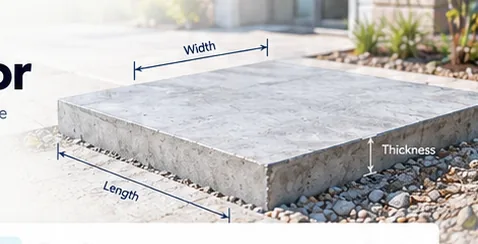
Calculate concrete for a patio, pad or several slabs with different thicknesses. Add each section, get one combined cubic-yard total and review the unrounded calculation before applying an optional allowance.
↯ Quick to use◎ Transparent math◇ Clear assumptions
Measure it this wayNot to scale · Measure the actual space to be filled, not a guessed outside dimension.
Slab or rectangular footingMeasure length and width horizontally in feet and concrete thickness vertically in inches. Example: a 10 ft × 10 ft slab with 4 in actual concrete thickness.
▦
Slab Calculator
Add one or several slab areas with their own thicknesses.
Multi-area worked example
How much concrete for slabs with different thicknesses?
Example: a 12 × 8 ft slab at 4 inches plus a separate 6 × 4 ft section at 6 inches.
First section: 12 × 8 × (4 ÷ 12) = 32 ft³. Second section: 6 × 4 × (6 ÷ 12) = 12 ft³. Total net volume: 44 ft³ = 1.63 yd³. With an illustrative 10% additional-material allowance, the combined volume is 48.4 ft³ = 1.79 yd³.
Calculate each section using its actual concrete-filled depth, add the unrounded volumes and apply the selected allowance once. This estimates quantity, not structural thickness or reinforcement. Convert your final volume to manufacturer-specific bags →
The process
How to measure a slab
Use actual dimensions of each region. Make each region separate when thickness changes.
1
Measure length
Find the usable length of each rectangular section in feet.
2
Measure width
Measure at right angles to the length; split irregular shapes into sections.
3
Measure thickness
Record the actual fill depth in inches for every section.
The geometry
Slab concrete volume formula
Use cubic feet for calculations; show cubic yards for supplier conversations.
Multiply the result by the number of identical slabs. To express cubic yards, divide by 27. For multiple unique sections, calculate each separately and add the unrounded volumes.
With allowance: total net ft³ × (1 + waste % ÷ 100). Do not round each slab prematurely or add waste twice.
What does each dimension mean?
Dimensions refer to the concrete space, not any surrounding frame or decorative surface.
Different thicknesses, slopes, thickened edges or irregular boundaries may require a separate volume zone and additional site measurements.
Worked example
Example: 16 × 12 ft patio, 4 inches thick
The prefilled Slab Calculator demonstrates this example with a separate, editable 10% allowance.
Calculate each stage
Slab area: 16 × 12 = 192 ft².
Convert thickness: 4 inches = 4/12 ft.
Volume: 192 × (4/12) = 64 ft³.
Net cubic yards: 64 ÷ 27 = 2.37037 yd³.
With 10% waste: 2.37037 × 1.10 = 2.60741 yd³.
2.61 yd³ waste-adjusted estimateThe result is displayed to two decimal places; supplier increments are separate.
Compare two slab sections
A patio extension might be 12 ft × 8 ft × 4 in while a detached step/pad may have another thickness. Enter each section individually, then let the tool total the physical volumes before adding your global allowance.
Example: 12 × 8 × 4 in = 32 ft³; 6 × 4 × 6 in = 12 ft³; combined net volume = 44 ft³ ≈ 1.63 yd³. At 10% waste, the estimate becomes about 1.79 yd³.
Avoid double counting: If a thickened edge is modeled separately, deduct any area already counted in the base slab, or add only its extra thickness.
Slab planning
Single slabs, multiple pads and unusual shapes
Choose the right method for the geometry you actually plan to pour.
Slab thickness is a design decision, not just a material estimate. The appropriate depth depends on use, soil/base preparation, loads, reinforcement, weather and applicable local rules.
This tool will calculate a user-entered thickness but does not certify that it is safe for patios, vehicle traffic or equipment foundations. Confirm the required design independently.
Do not copy generic thickness charts as permits or engineering advice. The calculation is useful after you have established the intended design dimensions.
Materials
Bags or ready-mix for the slab?
Bagged concrete may be suitable for smaller jobs, while delivered ready-mix can reduce the labor of mixing larger quantities. The right choice depends on supplier availability, crew/equipment and your pour plan.
A patio or equipment pad often has multiple sections or uneven fill depth. Keep volume, bag quantity and installed cost as separate decisions.
Use separate sections for changes in actual thickness or shape instead of averaging dissimilar areas without checking.
Material allowance is a planning input, not a substitute for measuring the prepared base.
Structural thickness, reinforcement and local construction requirements need a qualified local assessment.
Common questions
Frequently asked questions
Helpful answers about dimensions, rounding and placing an order.
How much concrete do I need for a 10 × 10 slab, 4 inches thick?
The net volume is 10 × 10 × (4/12) = 33.33 ft³, or about 1.23 yd³. With 10% allowance it becomes about 1.36 yd³.
What is the difference between a slab and a pad calculator?
For rectangular concrete, both use length × width × thickness. Slab or pad typically describes a project use, not a different physical volume formula.
Can I enter more than one slab?
Yes. Use Add another slab to enter a separate length, width, thickness and quantity for each independent area.
Is the waste percentage applied to each section separately?
The calculator sums all net slab volumes first, then applies the single global allowance one time to the total.
Does this tool calculate installation price?
No. Material volume is separate from labor, base preparation, reinforcement, delivery and contractor margin. Those require a dedicated cost estimate.
Does a 4-inch example mean 4 inches is adequate for my project?
No. The examples illustrate geometry only. A qualified professional and local requirements determine appropriate structural thickness and reinforcement.
Plan the next step
Related concrete calculators
Choose the tool that matches your next task. The specialized tools below are available now. Choose the one that matches your project.
Geometry comes from rectangular-prism volume and the exact conversion 1 yd³ = 27 ft³. See the general concrete calculator for other shapes. Specific bag yields and placement instructions must be verified against current manufacturer instructions, such as QUIKRETE Concrete Mix No. 1101 documentation. This is not a structural design, building-code or professional estimate.
Share your calculation or embed a free calculator
FREE MINI CALCULATORS FOR YOUR WEBSITE
Embed this free calculator
Share a working concrete-estimate widget with your readers. Choose a project type, then copy the three-line HTML snippet into your site’s custom HTML. It contains a visible, optional brand credit link in ordinary page HTML, even before JavaScript runs. The widget itself does not collect visitor inputs or set cookies.
SEND YOUR MEASUREMENTS
Copy shareable calculation link
Copy a link containing only current numeric measurements and selected modes. The new link uses a URL fragment (#) instead of query parameters (?), which does not create another HTTP page address. Prices, names and comments are excluded. Older query-based sharing links still work. Recheck dimensions and product yields before buying.
Need a paper copy? Use the existing Print estimate control alongside the calculator results.
WHY THESE ESTIMATES ARE CHECKABLE
Know the math before you buy
Independent estimating tools with transparent formulas, named product sources, seven reproducible QA baselines and engineering advisory support. Calculators provide quantity estimates, not structural designs or guaranteed supplier yields.