Start with material quantity
Measure the slab footprint and planned thickness. Convert cubic feet to cubic yards, apply any chosen allowance, then round to a supplier ordering increment when required.
Estimate the budget for a complete slab or small equipment pad. Enter real supplier prices, add your work items and see an itemized estimate without invented local rates.
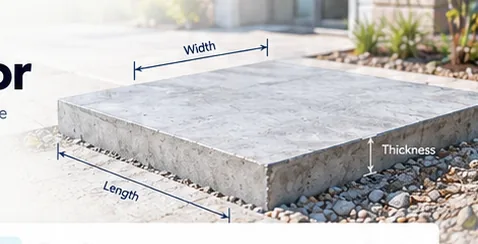
Start with slab dimensions and your own concrete price. For installed estimates, explicitly enter labor, delivery and site-prep values below (including confirmed zero amounts).
A cost estimate must distinguish the geometric amount of concrete from the price of a completed installation.
Measure the slab footprint and planned thickness. Convert cubic feet to cubic yards, apply any chosen allowance, then round to a supplier ordering increment when required.
Enter the quote for your concrete, in USD per cubic yard. Delivery, minimum total project charge, mobilization surcharge and short-load fees are distinct inputs, not part of the cubic-yards formula.
Base preparation, forms, reinforcement, labor, cleanup, equipment and site access can change the installed price far beyond the material-only cost.
A 10 ft × 10 ft slab at 4 in thick requires 1.23457 yd³ of concrete before allowance. At a hypothetical $180 per yd³ without supplier rounding, material cost would be about $222.22. A real installed estimate requires additional site-specific price inputs; do not treat this illustration as a local market quote.
Costs differ substantially by job size, material access and contractor scope. These categories should be explicit in any estimate.
A tiny HVAC or equipment pad can have a separately charged mobilization fee and a final minimum project price. These have different calculations.
A slab with excavation, compacted stone, lumber forms and reinforcement is not comparable to a material-only delivery.
With a $1,000 base expense, 20% markup means $1,200, while a 20% gross margin target means $1,250.
Concrete volume is only one part of an installed slab budget. Real local supplier and contractor prices should remain separate from assumed zeros.
Answers to real measurement and purchase questions. Product data and field conditions can change actual requirements.
No. It uses the prices you enter and clearly labeled illustration values. It does not access supplier inventory, local labor prices or ZIP-based live rates.
No. Installed work can include formwork, base preparation, reinforcement, delivery, labor, cleanup, permitting and overhead.
Some ready-mix suppliers charge an additional fee for a delivery smaller than their minimum shipment. Add it only if it appears on your quote.
The geometry is similar. Select the small-pad workflow and add relevant minimum, mobilization and site-access costs. This tool does not design anchors or equipment foundations.
These checks apply to the calculator above and help prevent expensive mistakes.
ft / in / ft³ / yd³ and product bag coverage all mean different things. Change a value only when you know the unit.
The geometric amount, adjusted quantity and supplier purchase increments should not be mistaken for one another.
Official product data is a starting point for planning. Check installation specifications and local requirements before use.
Choose the next task rather than making one calculator answer every question.
See the sources behind named product assumptions. These are not endorsements or live quotes.
Transparency: Calculators provide mathematical planning estimates. Product availability, real mixed yield, structural design, code requirements, and on-site conditions need independent verification. Always confirm current product specifications, installation instructions and local supplier requirements before purchasing.
Independent estimating tools with transparent formulas, named product sources, seven reproducible QA baselines and engineering advisory support. Calculators provide quantity estimates, not structural designs or guaranteed supplier yields.